When Claude 3 dropped, the discourse split into two camps immediately.
One camp: This changes everything; AI is going to replace half the workforce; the future is here.
Other camp: It's just autocomplete at scale; I asked it something, and it got it wrong; overrated.
Both camps missed the more useful question: for businesses actually trying to get work done, what does this change, specifically, and what does it not?
We've been building AI-powered operational systems for clients for long enough to have a clear-eyed answer.
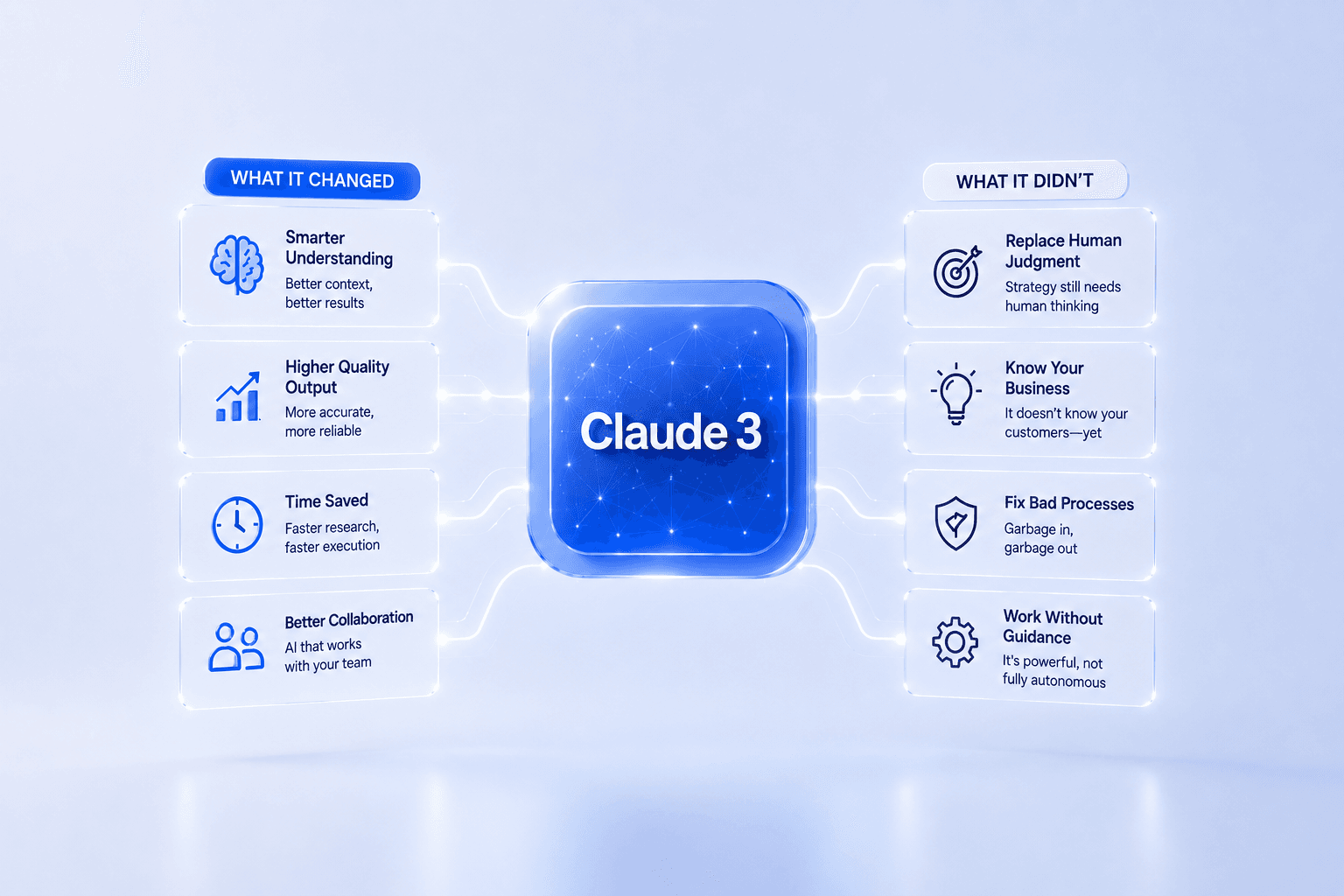
What Claude 3 actually changed:
The quality of generated first drafts improved meaningfully. Not to the point where a human doesn't need to review them—but to the point where the review takes 10 minutes instead of the draft taking 45. For client communications, internal documentation, proposal frameworks, and operational summaries, this is a real and compounding time saving.
The ability to process and synthesise long documents got genuinely useful. Feed Claude a 40-page report and ask it to surface the three most operationally relevant findings for a specific role—and it does them well. For businesses managing large volumes of information, this unlocks something that previously required a dedicated analyst.
Structured output from unstructured input became reliable enough to build systems on. This is the one most businesses aren't using yet. Claude can take a messy email, a voice note transcript, or a handwritten form scan and convert it into structured data with defined fields—reliably enough to feed into an automated workflow. That's the part that changes operations, not just individual productivity.
What it didn't change:
The need for process design. Claude can automate a workflow. It can't design a good one. Businesses that feed a broken process into an AI system get a faster, more consistent version of the same broken output. The thinking still has to happen upstream.
Accountability and judgment. Claude makes mistakes. Confident, well-articulated, plausible-sounding mistakes. Any operational system built on AI output needs human checkpoints at the decisions that matter. Not because AI is unreliable — because the cost of a confident wrong answer in a business context is real.
The integration work. The gap between 'Claude can do this' and 'Claude is doing this inside our operational system automatically' is still a build. The capability exists. The infrastructure to operationalize it has to be designed and built.
The businesses getting the most value from Claude right now are the ones treating it as infrastructure — embedded in specific, defined workflows where its capabilities are matched to the task — rather than as a general assistant that team members open occasionally and close without a clear use case.
That distinction is the difference between a tool and a system. And building the system is where the ROI lives.