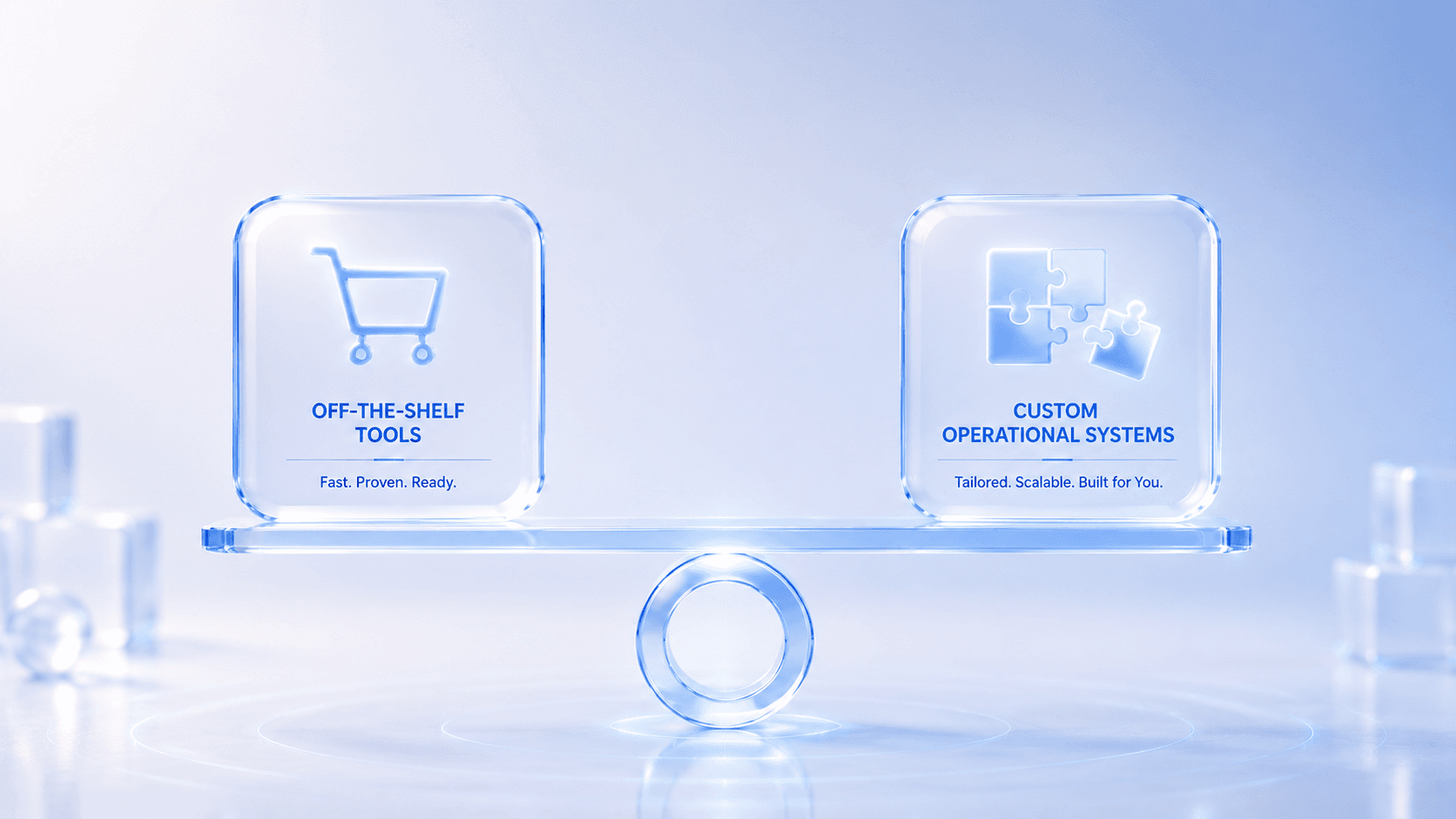
Every growing business eventually faces this decision: buy an off-the-shelf operations tool, or build something custom?
Both approaches have genuine merits. Both have real limitations. The wrong choice costs time, money, and team morale.
This post gives you a practical framework for making the right call — based on your business size, operational complexity, and growth trajectory.
The Case for Off-the-Shelf Tools
Off-the-shelf tools are faster to deploy, lower in upfront cost, and come with established support ecosystems. For businesses with standard workflows — where the tool was built for operations like yours — they work well.
If your team follows a process that thousands of other businesses follow in roughly the same way, an off-the-shelf tool is often the right choice. You get a proven system, regular updates, and a community of users who've solved the same problems you're facing.
The most common off-the-shelf options for operations management include general ticketing systems, project management platforms, and CRM-adjacent workflow tools. For many businesses, these are sufficient.
When Off-the-Shelf Stops Working
Off-the-shelf tools start to fail when your operations diverge from the assumptions baked into the product.
This typically happens when:
Your approval hierarchy doesn't match the tool's workflow model
Your SLA definitions are more granular than the platform supports
Your team structure spans multiple departments or regions in ways the tool doesn't accommodate
You need integrations the platform doesn't natively offer
Your reporting requirements are specific enough that the built-in reports don't surface what you actually need
When any of these apply, the typical response is to work around the system — using spreadsheets, manual steps, or workarounds to bridge the gaps. At that point, you've effectively built a semi-custom system on top of an off-the-shelf product. You're paying for both and getting the full benefits of neither.
The Case for Custom Operational Systems
A custom operational system is built around how your business actually works — not adapted from a template.
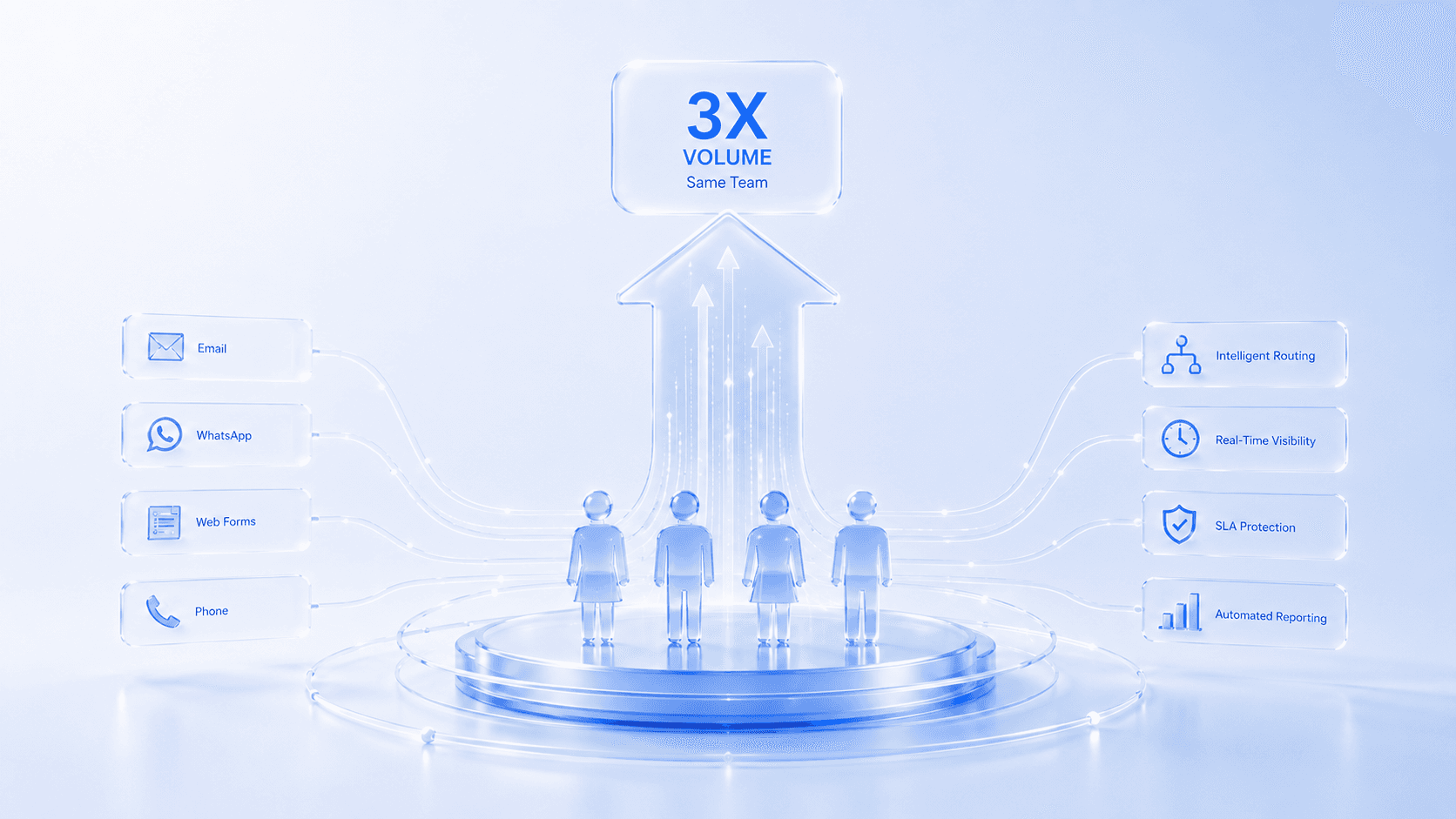
This means the intake flow reflects your real request channels. The routing logic matches your actual team structure. The dashboard surfaces the metrics your specific managers and executives need. The SLA definitions match your service commitments. The reports are generated in the format your leadership already uses.
The result is a system your team actually adopts — because it fits the way they work, rather than requiring them to change to fit it.
Custom systems also scale differently. Instead of hitting a ceiling imposed by the platform's feature set, you add capability as your operations evolve. Plugins, new integrations, expanded routing logic — all built to your specifications.
The Honest Trade-Offs
Custom systems require more upfront investment in time and cost. The discovery, design, and build phases take weeks — not hours.
They also require a partner who understands operations design, not just software development. A poorly designed custom system is worse than an off-the-shelf tool because it's harder to change and the institutional knowledge is concentrated in whoever built it.
The questions that determine which approach is right:
Is your workflow standard enough that an off-the-shelf tool handles it without significant workarounds?
What is the cost of the manual overhead your team carries because current tools don't fit your process?
Are you planning to scale significantly in the next 12–18 months, and will that growth increase operational complexity?
Does your competitive advantage depend partly on operational efficiency?
If the answer to any of the last three is yes, a custom operational system typically delivers better long-term ROI than accumulating off-the-shelf tools and managing the gaps between them.
A Hybrid Approach: What GenRes Recommends
The most cost-effective approach for most growing businesses isn't pure custom or pure off-the-shelf — it's a custom operational layer built on top of proven components.
This means using established infrastructure for the stable, standard parts of operations, while building custom logic for the workflows that are specific to your business. The result is faster deployment than full custom, with better fit than off-the-shelf.
GenRes designs every system this way. The Operational Audit phase identifies which parts of your workflow can run on proven components and which require custom design — so you're not paying for custom where standard will do.